
Searching for a Warrant in Webster County
Your first stop is Iowa Courts Online, the state's public index of trial-court cases. It covers many Webster County criminal and traffic dockets, but it is not an active-warrant list, and the help pages say its data is not an official court record. Treat a hit as a lead. A docket entry can flag something worth checking, yet only the court record and a live answer from the right office settle present status. Webster County splits its records across several doors on purpose. The Clerk of Court keeps the judicial file, the sheriff handles warrant service, jail routing, and law-enforcement records, and each city police agency holds its own incident reports. Iowa's IOWA System holds criminal-justice data too, but the public cannot search it. So a Webster County warrant search usually means the portal first, then a phone call to whichever office owns the file.
- Search Iowa Courts Online by name, exact date of birth, complete case ID, or citation number, and narrow the search to Webster County.
- Read the case type, events, dates, disposition, financial data, and any warrant or bond entry as a group.
- Call or email the Webster County Clerk of Court when an event is unclear, missing, old, or appears to concern failure to appear.
- Use sheriff records or the responsible city police custodian for service, return, incident, arrest, or jail questions.
- Ask about the courthouse public terminal or a focused records request when the free web index omits the needed document.
Webster County Warrant Lookup Portal
Iowa Courts Online is a case-search tool, not a Webster County warrant portal, and the difference matters. A name search may pull up several dockets at once. A case ID or citation search aims at just one. Pick the Trial Court search and apply the county filter where the site offers it. For names, the official help allows a percent sign as a wildcard, and a last or firm name needs at least two letters. An exact date-of-birth search demands the exact first name, last name, and date. The official Iowa Courts Online help spells out each search mode and its limits, and the official public search entry is where those options actually appear.
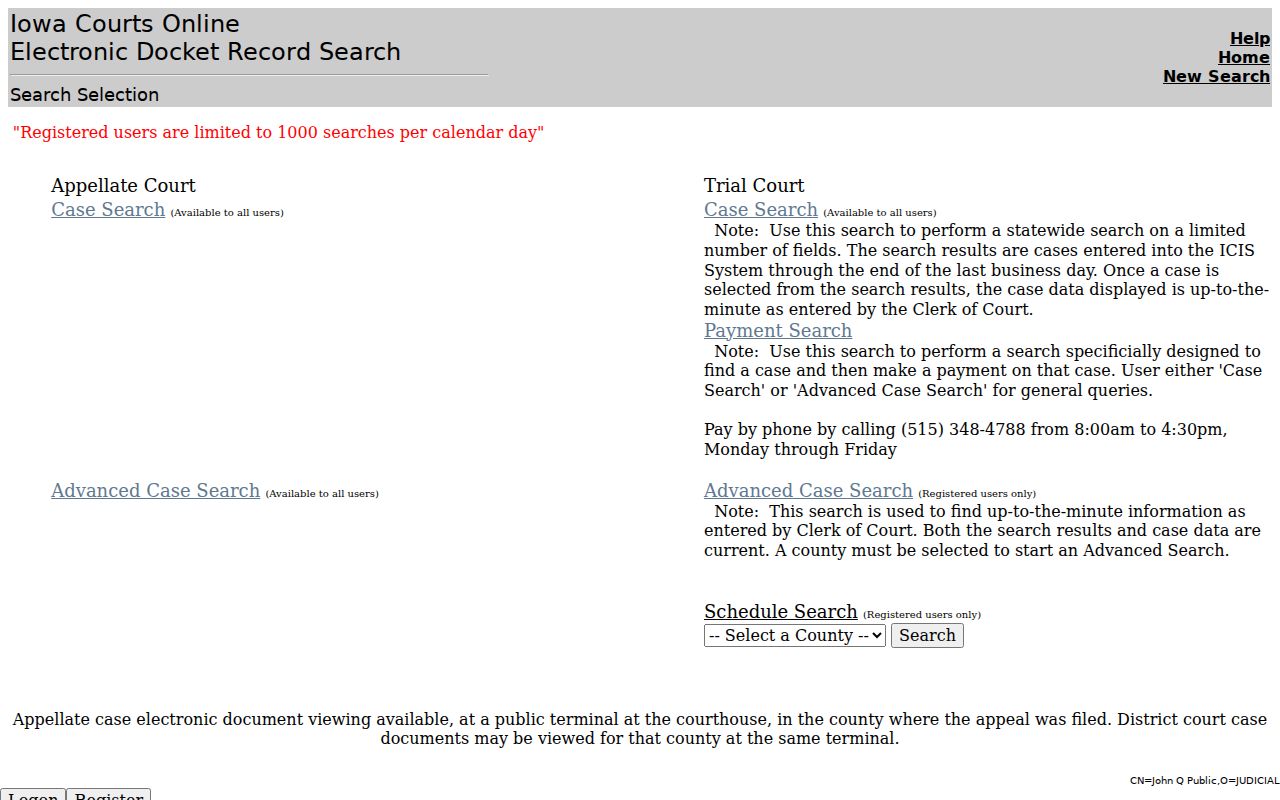
The screen can surface a Webster County case reference. It cannot replace a certified file, a clerk check, or a current answer from law enforcement.
Note: A public index hit is a lead to verify, while a no-hit is only the result of that search at that time.
Warrant Search Fields Explained
Use the narrowest field you can trust. A full legal name finds a docket, yet common names invite false matches in Webster County traffic and criminal files. Exact birth data helps when a person is checking a personal record. The full 17-character case ID is stronger still, because it points to one file. Keep every letter uppercase, and watch the difference between a zero and the letter O. A citation number works well for a traffic matter, though a fresh citation may take 10 to 14 days to appear.
| Field Label | Type | Required | Format Notes |
|---|---|---|---|
| Name | Text | Search dependent | At least two last-name letters; % wildcard is supported. |
| Date of Birth | Date | Exact DOB mode | Exact first and last name plus exact date. |
| Case ID | Text | Case mode | Use all 17 characters, uppercase; check 0 and O. |
| Citation Number | Text | Citation mode | Allow the official posting interval for a new ticket. |
| County | Selection | Recommended | Select Webster County instead of relying on a city. |
These fields search court dockets, not a Webster County sheriff roster, so a match still needs event-by-event review.
Webster County Warrant Number Pitfalls
A Webster County warrant lookup usually runs on a case number, since no separate public warrant number exists. The portal's case ID runs 17 characters. One mistyped character can bury the result you want, so copy the identifier straight from an official notice, keep its punctuation and case, and check each zero against each O. Never shorten it into a made-up local warrant format. Case-type codes only describe the docket category; they never prove a warrant is active. The official help lists FE, AG, SR, SM, OW, and traffic labels among them. A later docket entry may show that an earlier warrant was served, recalled, or quashed, which means the court canceled it. Read forward through the whole docket in Webster County before calling the clerk with the case ID and the event date in hand.
- Case ID
- The full identifier for one docket, such as 01311 FECR 012345.
- FTA
- Failure to appear for a required court event, not proof of current status.
- Recall
- A court action withdrawing a warrant before service.
- Quash
- A court order canceling or setting aside a warrant.
What a Warrant Search Shows
A Webster County result is organized around the case, not the warrant alone. Begin with the county and case ID. Then read the case type, charge description, filing dates, later docket events, disposition, and financial status. An open case or unpaid sum does not mean a warrant exists. Match any warrant-like event against the recall, service, bond, or disposition entries that follow it.
| Case ID | The docket identifier, for example 01311 SMCR 012345, not proof of an active warrant. |
|---|---|
| Charge or Description | The allegation, citation, or filing description. |
| Court and County | The Iowa trial-court location that owns the judicial file. |
| Docket Event | Event text and date, compared with all later entries. |
| Bond Data | Set and posted amounts may be separate; neither alone proves current status. |
| Disposition | The recorded outcome or case state, subject to clerk verification. |
Bond, service, and document details may sit behind a courthouse terminal or a subscription in Webster County. Even when the index shows service fields, the clerk or sheriff can route a current records question.
Webster County Warrant Search Delays
Traffic citations often take 10 to 14 days to post. A missing citation in that window does not mean the duty vanished. Keep the ticket, note the due date, and search again after the stated interval. If the court date has passed, or the result shows failure-to-appear language, call the Webster County Clerk rather than assuming online payment fixes everything. The Iowa Judicial Branch traffic FAQ explains the posting delay and the late-payment process. Its fine-payment instructions warn that paying online can amount to a guilty plea on an eligible citation, and payment does not necessarily recall a warrant. When a warrant or FTA entry shows, ask the clerk what the live Webster County docket requires before you pay.
Note: Posting delay, unpaid debt, license action, and an active warrant are distinct conditions that require separate confirmation.
Where to Check Warrants in Webster County
For a Webster County warrant search, two offices do most of the work. The Webster County Clerk of Court holds the Iowa District Court files at 701 Central Avenue, Fort Dodge, IA 50501, reachable at 515-576-7115 and countyclerk.webster@iowacourts.gov. A clerk can pull docket entries, copies, court dates, and fine details, and can walk you through confirming a warrant event. Ask about the public terminal, too. It sometimes shows material the free online index leaves out. The Webster County Sheriff's Office handles execution of search and arrest warrants, with Civil Process and Records at 515-573-1410, 702 1st Avenue South. For emergencies, dispatch answers at 515-573-2323, and the jail number is 515-573-1462. Day-to-day warrant questions go to the clerk or records staff rather than dispatch. City clerks keep administrative files, but a criminal or traffic warrant in Webster County runs through the district court, not a city counter, and no separate municipal criminal court portal exists here. Municipal infractions proceed in Iowa District Court under Iowa Code section 364.22.
Webster County Warrants and IOWA
Iowa does have a true statewide warrant system, but you cannot use it. The IOWA System, short for Iowa On-line Warrants and Articles, ties criminal-justice agencies together across the state network. Access is restricted. That is why an officer may see current warrant data that no public court index or county website displays. For the public, the fallback is Iowa Courts Online, then the county clerk and the law-enforcement office holding the record. A Webster County warrant lookup stops at the state line, so keep your sources separate. Federal dockets run through the Northern District of Iowa and PACER, and sealed federal warrants may never surface publicly. For a plain-language description of how the system works, see the Iowa Department of Public Safety description of IOWA.
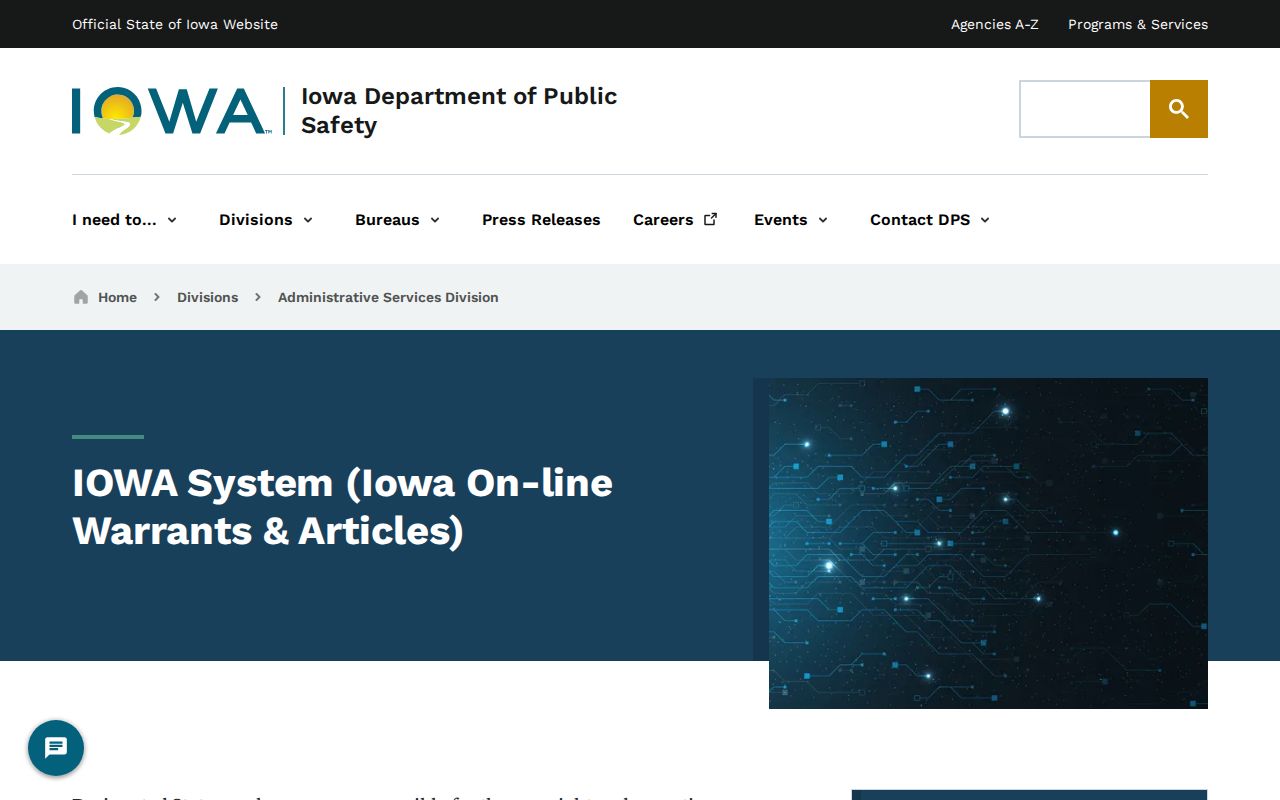
It documents the agency network, not a public self-search product.
Restricted Warrants and Access Rules
Not every warrant record is open. Iowa Courts Online blocks juvenile and confidential cases, and court rules plus the Iowa Public Records Law allow sealing, restriction, redaction, or withholding when a legal exception applies. Sealed data can cover Social Security numbers, account numbers, dates of birth, minors' names, unique identifiers, victim data, and parts of an active investigation. When you make a records request in Webster County, be specific. Name the custodian, the record type, your case or incident number, the date range, and how you want delivery. The Judicial Branch public-record process accepts verbal or written requests during regular hours, though complex work may need writing. Expect possible fees for search, retrieval, review, redaction, programming, copies, and postage.
Key Rules: A sealed or confidential warrant may not appear publicly. Juvenile matters are restricted. An active investigation may also limit disclosure.
A missing public result is not proof that no Webster County warrant exists. Verify time-sensitive status with the clerk or responsible agency.
Confirming a Webster County Warrant
Suppose your own Webster County result shows an FTA, a warrant event, a bond entry, or an unresolved setting. Save the case ID and event date, but copy nothing protected. Read every entry after it. Then call the Webster County Clerk and ask three things: which public record confirms current status, what the next event is, and what ordinary court procedure applies. A lawyer or public defender can explain your case-specific choices. Watch for payment scams, too. The Iowa Judicial Branch warns that courts and law enforcement never demand fines through gift cards, cryptocurrency, text, or email, so find the clerk number on the official court page and call it yourself. If service or custody routing comes up, use the official sheriff contacts. A current warrant carries real consequences, and evading service only makes things worse, so treat any web index as a lead rather than a legal answer. For more on list status, see the county's outstanding warrant process.
Act carefully: Confirm the event with the clerk and seek legal advice before arranging an appearance, bond, or voluntary surrender.